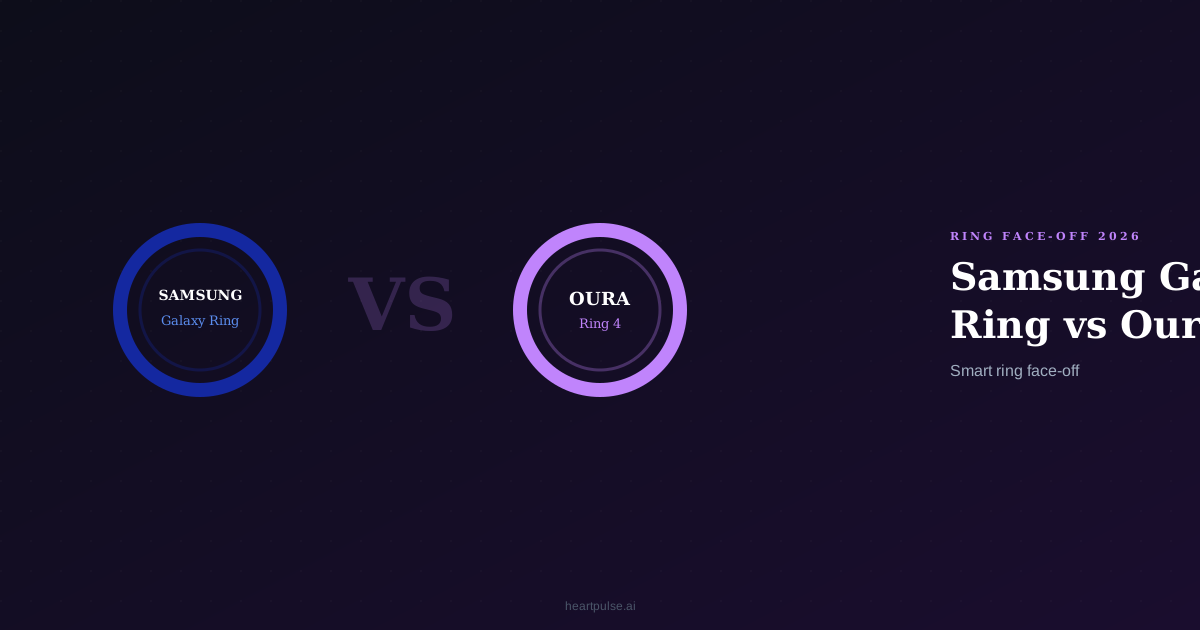
Samsung entered the smart ring market with massive brand recognition and deep hardware expertise. The Galaxy Ring is Samsung's first screenless wearable, aimed at users who want health data without another glowing rectangle on their body.
Oura has been doing this since 2015. Four hardware generations. Over 500 million nights of sleep data. Published validation studies in peer-reviewed journals. The question: can a first-generation ring from a smartphone company match a fourth-generation ring from a sleep company?
We wore both rings simultaneously for 45 days to find out.
Quick Verdict
Oura Ring 4
Superior sensor accuracy, validated sleep staging, SpO2, and illness detection make Oura the better health ring. Samsung wins on design, cost, and ecosystem integration.
$399
Samsung Galaxy Ring
No subscription required
$349
Oura Ring 4
+ $5.99/mo subscription for full features
~70%
Galaxy Ring sleep accuracy
Epoch-by-epoch vs. PSG (estimated)
~78%
Oura Ring 4 sleep accuracy
Epoch-by-epoch vs. PSG (validated)
Design: Two Philosophies in Titanium
Samsung Galaxy Ring is the lightest smart ring ever made at 2.3--3.0g. It uses two LEDs (green + infrared), ships in 9 sizes and 3 finishes, and comes with a portable charging case that holds 1.5 full charges. Adaptation period for first-time ring wearers is essentially zero.
Oura Ring 4 is heavier (4--6g) but thinner (2.0--2.5mm vs 2.6mm). Three-wavelength LEDs (green + red + infrared), 5 finishes, and a sensor bump refined over four generations for smooth overnight wear.
| Feature | Samsung Galaxy Ring | Oura Ring 4 |
|---|---|---|
| Weight | 2.3–3.0g | 4–6g |
| Thickness | 2.6mm | 2.0–2.5mm |
| LED Sensors | Green + Infrared (2) | Green + Red + Infrared (3) |
| SpO2 | No | Yes |
| Water Resistance | 10 ATM | 10 ATM |
| Sizes | 5–13 | 6–13 |
| Finishes | 3 | 5 |
| Portable Charging | Yes (case with battery) | No |
Samsung's Charging Case Advantage
The clamshell case holds a 361 mAh battery -- enough for 1.5 full ring charges on the go. For travelers and forgetful chargers, this is a genuine convenience edge no other ring offers.
Sensor Accuracy: The Gap That Matters
The two-vs-three wavelength difference cascades through every metric. Oura's third wavelength (red, 660nm) enables SpO2 measurement and multi-channel signal fusion that produces a cleaner reading across the board.
| Metric | Samsung | Oura |
|---|---|---|
| Resting HR (vs. chest strap) | +-1.5 bpm | +-0.8 bpm |
| HRV rMSSD (vs. clinical) | +-6.8 ms | +-3.2 ms |
| Skin temp resolution | +-0.1C | +-0.05C |
| SpO2 | Not available | Yes (continuous overnight) |
| Sleep staging (vs. PSG) | ~70% | ~78% |
| Sleep onset detection | Within 10 min | Within 5 min |
The HRV gap -- +-6.8 ms vs +-3.2 ms -- is the number that matters most. Noisier HRV means less accurate sleep staging, less sensitive trend detection, and slower recovery alerts downstream.
Why the Third Wavelength Matters
Green light captures real-time heart rate. Infrared penetrates deeper for nighttime HRV. Red light differentiates oxygenated from deoxygenated blood (pulse oximetry). Without red, Samsung cannot measure SpO2. Oura fuses all three channels into a signal more robust than any single wavelength alone.
Sleep Tracking: Samsung's Biggest Gap
Oura (~78% epoch accuracy) uses a neural network trained on 500M+ labeled nights, validated in peer-reviewed studies. Deep sleep estimates are conservative and clinically aligned.
Samsung (~70% estimated) adapts Galaxy Watch algorithms to the ring form factor. Deep sleep estimates ran 15--22 minutes higher than Oura on the same nights -- classic N3 overcounting from a less mature algorithm. Samsung has published limited ring-specific validation data.
The Validation Gap
Oura has multiple peer-reviewed, independent sleep staging studies. Samsung references Watch-based validation, but finger and wrist produce different signal characteristics. Until Samsung publishes ring-specific studies, the ~70% figure is based on comparative testing, not peer-reviewed confirmation.
sleep-tracking-comparison
Unify all your wearable data and get personalized AI health insights in one place.
Recovery Scores: Readiness vs Energy
Oura's Readiness Score integrates five data streams: HRV trend, resting heart rate, skin temperature, sleep quality, and multi-day activity balance. In our testing, it detected a mild cold onset via temperature deviation a full day before Samsung's Energy Score reflected any change.
Samsung's Energy Score weighs sleep duration heavily and incorporates HRV and activity. Useful, but less sensitive to subtle physiological shifts due to the noisier underlying sensor data.
Cost Breakdown
| Period | Samsung | Oura |
|---|---|---|
| Hardware | $399 | $349 |
| 3-Year Total | $399 | $559 |
| 5-Year Total | $399 | $699 |
| Monthly (3-yr) | $11.08 | $15.53 |
Samsung costs $160 less over 3 years and $300 less over 5. The financial case is clear. The counterargument: Oura's subscription funds the largest wearable sleep research team in the industry, with measurable accuracy improvements generation over generation.
✓Pros
- Samsung: Lightest ring ever made (2.3-3.0g), zero adaptation period
- Samsung: No subscription -- all features included forever
- Samsung: Portable charging case with built-in battery
- Samsung: Deep Galaxy ecosystem integration
- Oura: Best sleep staging accuracy (78% validated)
- Oura: SpO2 tracking and illness early detection
- Oura: Works on both iOS and Android
- Oura: 5-input Readiness Score with temperature deviation
✗Cons
- Samsung: Android only -- zero iOS support
- Samsung: No SpO2, no sleep apnea screening
- Samsung: HRV noise roughly 2x higher than Oura
- Samsung: No ring-specific validation studies published
- Oura: Mandatory $5.99/mo subscription
- Oura: Heavier (4-6g vs 2.3-3.0g)
- Oura: No portable charging solution
- Oura: Limited automatic workout detection
Category Winners
Sleep Tracking Accuracy
Oura Ring 4 Winner
78% validated accuracy, 500M+ nights of training data, three-wavelength sensors. The 8-point gap over Samsung is clinically meaningful.
Runner-up: Samsung Galaxy Ring
Design and Comfort
Samsung Galaxy Ring Winner
Lightest smart ring ever at 2.3-3.0g with a portable charging case. Zero adaptation period for first-time wearers.
Runner-up: Oura Ring 4
Value for Money
Samsung Galaxy Ring Winner
$399 total cost forever. No subscription, no paywall, no feature gating. $300 less than Oura over 5 years.
Runner-up: Oura Ring 4
Health Monitoring Depth
Oura Ring 4 Winner
SpO2, high-resolution temperature, multi-variable illness detection, chronotype classification, and FDA-cleared menstrual tracking via Natural Cycles.
Runner-up: Samsung Galaxy Ring
Frequently Asked Questions
No. The Galaxy Ring requires an Android phone, and full features require a Samsung Galaxy device specifically. If you use an iPhone, Oura Ring 4 is your only option between these two.
Oura tracks continuous overnight SpO2 and can flag desaturation patterns consistent with obstructive sleep apnea (not FDA-cleared for diagnosis). Samsung has no SpO2 sensor and cannot screen for apnea at all.
Almost certainly. Samsung has the resources and incentive. But the Galaxy Ring 2 is not expected until at least late 2027. In 2026, the accuracy gap is real.
If you engage deeply with Readiness Scores, HRV trends, and temperature illness detection, yes -- you are paying for insights from the most accurate consumer sleep algorithm available. If you just want basic sleep duration and quality, Samsung delivers that without recurring costs.
Yes. One per hand works without interference. We conducted our entire 45-day test this way. For daily use, pick one based on your priorities rather than doubling up.