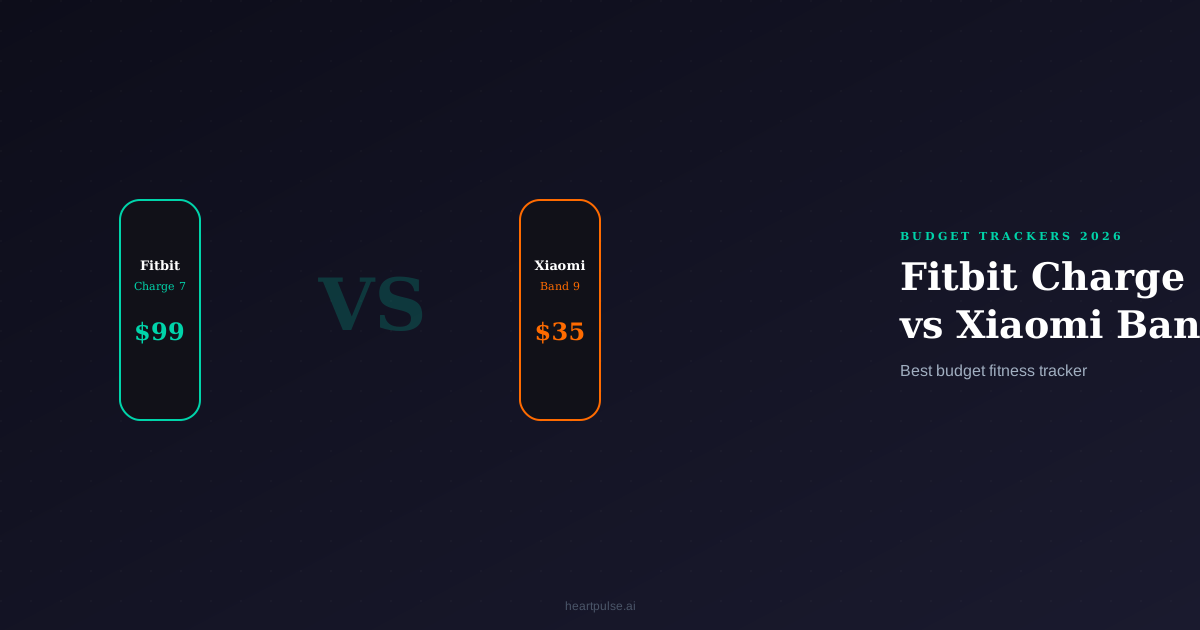
The myth that good health data richiede a $300+ smartwatch is dead. The Fitbit Charge 7 ($150) and Xiaomi Smart Band 9 ($40) both deliver continuous HR monitoring, SpO2, staging del sonno, stress tracking, and workout logging. Five anni ago, that demanded $300 and a chunky watch. Today, it fits in a band piu leggero di a house key.
The question non e whether budget trackers are good enough. They are. La domanda e where the $110 gap is justified.
$150
Fitbit Charge 7
Google's flagship fitness band
$40
Xiaomi Smart Band 9
The global budget benchmark
7 days
Fitbit battery life
Typical use, AOD off
10 days
Xiaomi battery life
Typical use, AOD off
Verdetto rapido
Xiaomi Smart Band 9
For ~70% of buyers, the Xiaomi is 'good enough' at $40 with zero subscriptions. The Fitbit is the better tracker -- but whether that's worth 4x more depends on you.
The Spec Sheet
| Feature | Spec | Fitbit Charge 7 | Xiaomi Smart Band 9 |
|---|---|---|---|
| Prezzo | ~$150 | ~$40 | |
| Display | 1.04" AMOLED, 450 nits | 1.62" AMOLED, 600 nits | |
| Peso | 28g | 16g | |
| HR Sensor | Multi-path PPG | Single-path PPG | |
| GPS integrato | Si | No (connected GPS via phone) | |
| Skin Temperature | Si | No | |
| EDA Stress Sensor | Yes (direct measurement) | No (HRV-derived only) | |
| SpO2 | Continuous notturno/a | Periodic sampling | |
| Batteria | 6–7 days | 9–10 days | |
| Water Resistance | 5 ATM (50m) | 5 ATM (50m) | |
| NFC Payments | Google Wallet | Xiaomi Pay (regional) | |
| Workout Modes | 40+ | 150+ | |
| Abbonamento | $9.99/mo Premium (optional) | Nessuno |
The Xiaomi has a bigger, brighter display, longer battery, more workout modes, and weighs half as much. The Fitbit counters with GPS integrato, temperatura cutanea, EDA stress sensor, and the multi-path PPG that drives meaningfully more accurate frequenza cardiaca and sleep data.
Frequenza cardiaca: Where the Price Gap Shows
Entrambi usano optical PPG (green LEDs reading blood flow). The Fitbe multi-path sensor cross-references multiple optical paths, reducing motion artifact. The Xiaomi's single-path sensor is good at rest but struggles during intense movement.
| Scenario | Fitbit Charge 7 | Xiaomi Smart Band 9 |
|---|---|---|
| Resting | ±1–2 bpm | ±1–3 bpm |
| Walking | ±2–3 bpm | ±3–5 bpm |
| Steady running | ±3–5 bpm | ±5–8 bpm |
| HIIT / intervals | ±5–8 bpm | ±8–15 bpm |
| Weightlifting | ±4–7 bpm | ±7–12 bpm |
| Sleep | ±1 bpm | ±1–2 bpm |
At rest, both are excellent. During high-intensity training -- when HR data matters most -- the Fitbit pulls ahead significativamente.
Why Wrist HR Is Never Perfect During Exercise
The movements that raise your heart rate also move the sensor on your skin. No wrist device at any price elimina this. For accurate HR zone training during intense exercise, a chest strap remains the gold standard.
Monitoraggio del sonno
Fitbe advantage is meaningful here. ~72% epoch precisione vs. Xiaomi's ~64% -- closer to WHOOP (~73%) than to budget territory. Il divario comes from cleaner HRV data via multi-path PPG and Fitbe massive training dataset (22+ billion nights).
| Feature | Feature | Fitbit Charge 7 | Xiaomi Smart Band 9 |
|---|---|---|---|
| Staging precisione (vs. PSG) | Staging precisione (vs. PSG) | ~72% | ~64% |
| Deep sleep detection | Deep sleep detection | ~68% | ~58% |
| REM detection | REM detection | ~66% | ~57% |
| Overnight SpO2 | Overnight SpO2 | Continuous | Periodic |
| Skin temperature | Skin temperature | Si | No |
| Snoring detection | Snoring detection | Yes (via phone mic) | No |
| Smart alarm | Smart alarm | Si | Si |
Xiaomi's monitoraggio del sonno is adequate for broad trends -- are you getting enough sleep, is sonno profondo tendenza up or down. Fitbe is reliable enough for night-to-night analysis.
Monitoraggio del sonno Tip
Wear the band snugly, one finger-width above the wrist bone. Loose bands shift during sleep, degrading precisione for both devices. User compliance is the single largest variable.
fitness tracking and health data integration
Unify all your wearable data and get personalized AI health insights in one place.
Fitbe Health Extras
Three presenta the Xiaomi simply cannot match:
Temperatura cutanea sensor -- measures wrist temp deviation nightly. A +1.0°F deviation over 2+ nights is a reliable illness early warning, often 24--48 ore before symptoms. Validato during COVID-19 and flu studies.
EDA stress sensor -- direct electrodermal measurement of sympathetic nervous system activation. Unlike Xiaomi's HRV-derived stress score, this is a direct physiological signal through a separate pathway.
GPS integrato -- accurate pace, distance, and route recording without a phone. For runners training by pace zones, this is non-negotiable.
The Subscription Problem
Factor in Total Cost
Several of Fitbit's best presenta -- Daily Readiness Score, advanced sleep analytics, guided workouts -- require Fitbit Premium at $9.99/month. Over 2 years: Fitbit + Premium = $310. Xiaomi = $40 total. Il divario is $270. Without Premium, Fitbit is $150 but the experience feels notevolmente gated.
The Xiaomi has nessun abbonamento. Every feature works dal primo giorno.
Durata della batteria
| Usage | Fitbit Charge 7 | Xiaomi Smart Band 9 |
|---|---|---|
| Typical (HR on, AOD off) | 6–7 days | 9–10 days |
| Always-On Display | 3–4 days | 5–6 days |
| Heavy GPS use | 4–5 days | N/A |
| Power-saving mode | Up to 10 days | Up to 18 days |
| Charge time | ~90 min | ~60 min |
Xiaomi's 40% longer battery means fewer charge cycles, fewer data gaps, and less opportunity to forget putting the tracker back on.
Valutazioni
✓Pros
- Most accurate HR and sleep tracking in the fitness band category
- GPS integrato for phone-free outdoor tracking
- Skin temperature sensor for illness early warning
- EDA stress sensor -- direct autonomic measurement
- Excellent app with deep health analytics
- Google Wallet NFC payments
- Smart alarm wakes during light sleep
✗Cons
- $150 is nearly 4x the Xiaomi's price
- Best presenta locked behind $10/mo Premium
- 6–7 day battery vs. Xiaomi's 9–10
- Proprietary charging cable
- Smaller display (1.04" vs. 1.62")
- Fitbit's future under Google has frustrated longtime users
✓Pros
- $40 with zero subscription fees
- 9–10 day battery elimina charging anxiety
- Large 1.62" AMOLED at 600 nits
- 16g -- praticamente imperceptible during sleep
- 150+ workout modes
- Fast 60-minute charging
- Huge global accessory ecosystem
✗Cons
- No GPS integrato
- HR precisione drops during high-intensity exercise
- Sleep staging adequate for trends, not night-to-night
- No skin temperature sensor
- No EDA stress measurement
- Mi Fitness app manca di depth
- SpO2 monitoring is periodic, not continuous
Chi dovrebbe comprare cosa?
| Profile | Best Choice | Why |
|---|---|---|
| Runner training by pace zones | Fitbit Charge 7 | GPS integrato, no phone needed |
| Budget-conscious, basic health tracking | Xiaomi Smart Band 9 | $40, no subscription, solid fundamentals |
| Sleep optimizer | Fitbit Charge 7 | 72% staging precisione + SpO2 + skin temp |
| Casual walker / yoga | Xiaomi Smart Band 9 | Quality difference is negligible at low intensity |
| Hates subscriptions | Xiaomi Smart Band 9 | All presenta included, forever |
| Swimmer wanting HR in pool | Fitbit Charge 7 | Tracks HR underwater; Xiaomi does not |
| First-time tracker | Xiaomi Smart Band 9 | $40 low-risk entry point |
| Google/MyFitnessPal ecosystem | Fitbit Charge 7 | Deepest Google Health integration |
Precisionee della frequenza cardiaca
Fitbit Charge 7 Winner
Multi-path PPG offre meaningfully better data during exercise, where precisione matters most.
Runner-up: Xiaomi Smart Band 9
Rapporto qualita-prezzo
Xiaomi Smart Band 9 Winner
80% of the tracking at 27% of the price, zero subscription. The value proposition is overwhelming.
Runner-up: Fitbit Charge 7
Durata della batteria
Xiaomi Smart Band 9 Winner
9–10 days real-world vs. 6–7 for Fitbit. Fewer charges = fewer data gaps.
Runner-up: Fitbit Charge 7
Migliore per runner
Fitbit Charge 7 Winner
GPS integrato records accurate pace and route without a phone. Non-negotiable for pace-zone training.
Runner-up: Xiaomi Smart Band 9
Frequently Asked Questions
For runners (GPS), sleep optimizers (72% staging precisione), and those who value skin temperature tracking -- yes. For casual users who walk, do light exercise, and want basic health awareness, the Xiaomi gives 80% of the experience at 27% of the cost.
Not strictly, but the experience without it is notevolmente gated. Daily Readiness Score, advanced sleep analytics, and guided workouts all require Premium ($10/mo). If you lascia perdere, you have excellent hardware with artificially limited software.
Yes -- 5 ATM rated with pool swimming modes for stroke/lap tracking. However, it does not track heart rate during swimming. The Fitbit does.
Fitbit Charge 7, objectively. 72% staging precisione vs. 64%, plus continuous SpO2, skin temperature, and snoring detection. If sleep quality drives your purchase decision, the Fitbit is the clear choice.
Both are designed for 2–3 years of 24/7 wear before battery degradation becomes noticeable. Xiaomi bands cost $5–10 to replace every 6–12 months; Fitbit bands run $15–25.